Changing Political Landscape
New York City Looks Different After The Election
For the past four years, New York City mayor Eric Adams has been viewed as a moderate who clashed with an increasingly progressive and independent City Council. This was a contrast to the previous administration, where Mayor Bill de Blasio and the City Council were more often in lock step on policy and passing bills, with very few public tiffs between the two.
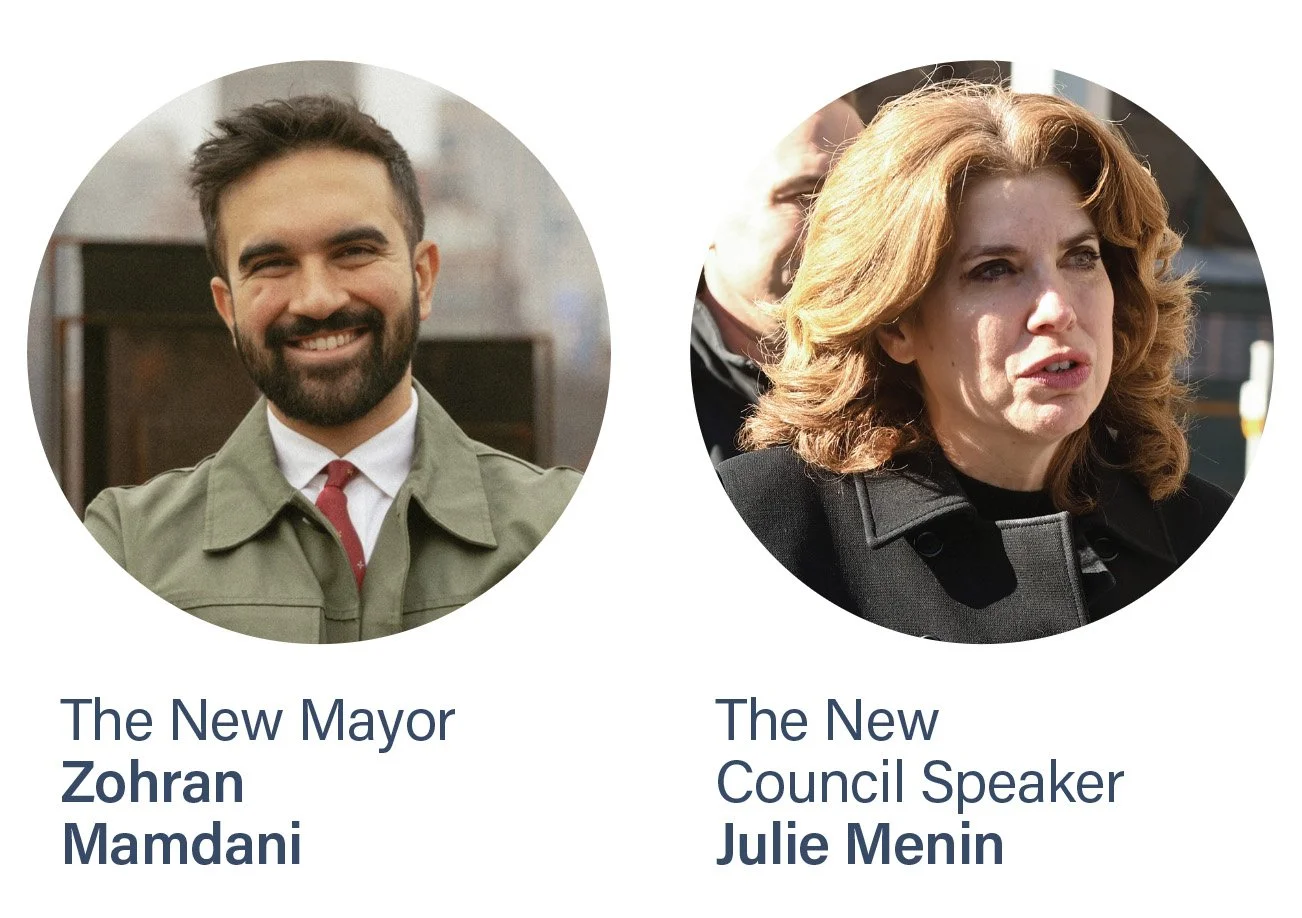
Heading into 2026, we may be going back to the previous way things worked. Democratic Socialist Mayor Zohran Mamdani will be sworn in on January 1st and the City Council will have nine new members. The new City Council Speaker will be elected on January 7, but Manhattan Democrat Julie Menin has already declared victory after a supermajority of incoming members voiced public support for her.
The members of the Council who did not support Menin’s candidacy were mostly members of the Progressive Caucus and some of Mamdani’s biggest supporters. This has led to speculation that the Council may be a moderating force on the socialist platform of Mamdani. This narrative may bear out, but historically the relationships between Mayor’s offices and the City Council have been defined less by ideology and more by personal relationships.
The first big test for the Mayor, and the City Council, will be the 2026 budget. Even before the election, projections for future years showed that there would be declining revenue to pay for the city’s safety net. This will force the mayor and Council to make difficult decisions.
For example, there has been a declining student population in public schools, which means there will be less state revenue. To fill that gap, the city would have to put a larger portion of their budget to the schools or teachers will be laid off.
Another conflict point could be the city’s CityFHEPs voucher program. It has grown to a commitment of more than $1 billion annually as the city deals with the severe housing affordability crisis. Already the city has started to take steps to rein in the spending, by eliminating incentives for property owners to hold units for voucher holders for a few months as paperwork is sorted out. If the mayor and City Council have to choose between vouchers and teachers, what will they do?
In an attempt to head off these difficult decisions, the city is likely going to aggressively lobby the state legislature for more funding to cover budget gaps. It’s unclear if they will get it. 2026 is a re-election year for the state legislature and for Governor Hochul. Historically, lawmakers are less inclined to take bold swings on policy reforms in election years and mostly focus on delivering targeted help to key voting blocs in order to secure re-election. If the state government is going to operate in the status quo, then there won’t be a lifeline to New York City’s budget problems.
The New Mayor
Zohran Mamdani
He was born in Kampala, Uganda and moved to New York City when he was seven years old.
He graduated from Bronx High School of Science
Prior to his political career, he worked as a foreclosure prevention counselor
He has represented parts of Queens in the Assembly since 2021
He will be the first Muslim and South Asian Mayor of New York City
Mamdani campaigned on a platform of freezing rent-stabilized rents, universal public child care, fast and free buses, and creating city-owned grocery stores.
When he is sworn in, he will become the youngest mayor of New York City in more than 100 years
The New Council Speaker
Julie Menin
– – –
Former Attorney at Wiley, Rein & Fielding
Founded nonprofit Wall Street Rising after 9/11
Ran for Manhattan Borough President in 2013
Served as the Commissioner of NYC Consumer Affairs
Served as Commissioner of Mayor's Office of Media and Entertainment
Served as Director of the Census for NYC for 2020.
Elected to City Council in 2021, representing the Upper East Side
Chaired the Council’s Small Business Committee
In 2024, Menin supported the City of Yes for Housing Opportunity, the largest upzoning of the city in more than 50 years.